
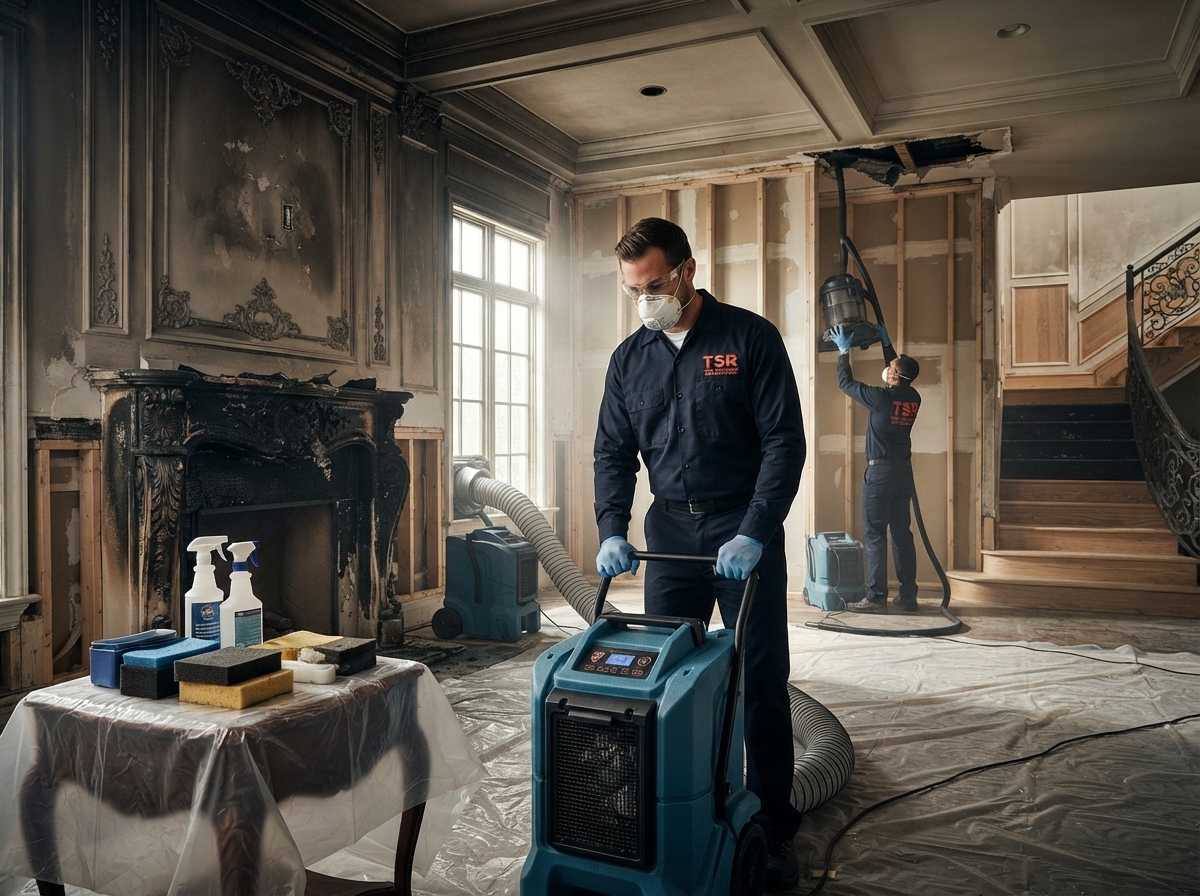
A structural fire in a luxury residence or commercial property is a devastating crisis that goes far beyond visible surface charring. From modern architectural estates in Trousdale Estates to historic properties in the Beverly Hills Flats and high-end retail suites near Rodeo Drive, fire losses present a complex web of destruction.
Beyond active flames, property owners face corrosive acidic soot, intrusive chemical smoke odors, and thousands of gallons of high-pressure firefighting water saturating custom finishes. Executing immediate, certified fire and smoke damage restoration within the first 24 to 72 hours is critical to neutralizing toxic residues, extracting standing water, and halting permanent chemical etching on high-value materials.
The Critical First 24 to 72 Hours: A Timeline of Chemical Degradation
Synthetic materials, luxury upholstery, and architectural finishes release toxic, highly acidic combustion byproducts when burned. If left untreated, lingering soot and heat-driven moisture actively degrade structural and aesthetic elements hour by hour.
| Time Elapsed | Physical & Chemical Impact | Required Technical Restoration Action |
| 0 – 4 Hours | Acidic soot residue covers all surfaces; synthetic materials emit toxic gas; firefighting water pools on subfloors. | Emergency board-up, roof tarping, liquid water extraction, thermal moisture mapping. |
| 4 – 24 Hours | Yellowing occurs on fiberglass and finishes; soot permanently etches glass, brass hardware, and grout lines. | Chemical soot neutralization, HEPA air scrubbing, LGR structural drying installation. |
| 24 – 72 Hours | Acidic residue causes irreversible pitting on imported marble and metal trim; drywall absorbs heavy smoke odors. | White-glove content pack-out, wall surface washing, molecular thermal fogging. |
| 72+ Hours to Days | Smoke odors penetrate deep inside wood framing; subfloors delaminate; complete material replacement required. | Controlled structural demolition, thermal hydroxyl deodorization, full architectural rebuild. |
The Dual-Mitigation Challenge: Resolving the “Water After Fire” Paradox
A major aspect of fire recovery often overlooked is the extensive water damage left behind by firefighting efforts. High-pressure fire hoses flood lower levels, subterranean wine vaults, and home theaters with thousands of gallons of water.
At Tech Solution Restoration, we perform simultaneous dual mitigation:
Emergency Fire and Smoke Loss Recovery Workflow
Full architectural reconstruction
Phase 1: Emergency Incident Assessment
Immediate multi-track dispatch and containment setup.
Phase 2: Simultaneous Dual Mitigation (Parallel Execution)
Branch A — Water Extraction & Structural Drying
High-volume truck extraction
LGR dehumidification & directional air movers
Thermal imaging moisture mapping
Branch B — Soot Neutralization & Chemical Containment
Emergency roof tarping & board-up
Dry carbon & wet soot wash
HEPA air scrubbing & negative pressure containment
Phase 3: Final Recovery & Reconstruction
Molecular Deodorization & Structural Rebuild
Hydroxyl / Ozone oxidation
- Immediate Liquid Extraction: We deploy truck-mounted extractors to remove standing firefighting water before subfloors warp or fungal spores germinate.
- Closed-Loop Structural Drying: Commercial Low-Grain Refrigerant (LGR) dehumidifiers and axial air movers extract trapped moisture from wall studs and floor joists while soot remediation takes place simultaneously.
Technical Breakdown: Soot Chemistry & Molecular Deodorization
Cleaning up fire loss requires a scientific approach to chemical residues and odor molecules. Generic surface wiping is ineffective against complex combustion byproducts.
1. Identifying the 4 Distinct Soot Types
- Dry Carbon Soot: Formed by fast-burning, high-temperature wood and paper fires. Easily cleaned using specialized dry chemical sponges when addressed quickly.
- Wet Synthetic Soot: Produced by smoldering plastic, rubber, and synthetic fabric fires. Highly smeary, sticky, and acidic; requires heavy solvent-based degreasers.
- Protein Residue Film: An invisible, highly pungent film caused by low-heat kitchen grease fires. It discolors paints and lacquers and requires specialized enzyme neutralizing washes.
- Furnace Puff-Back Soot: Oil-based heating system malfunctions that distribute fine petroleum soot throughout the entire HVAC ductwork network.
2. Molecular Deodorization Technology
Smoke odor particles are driven deep into porous framing materials, custom plaster, and wood fibers by heat expansion. Masking agents cannot eliminate these smells. We deploy advanced molecular neutralization equipment:
- Hydroxyl Generators: Utilize UV light technology to break down organic odor molecules safely in occupied spaces without damaging sensitive fine art or electronics.
- Thermal Fogging: Replicates the tiny particle size of fire smoke, carrying EPA-registered counteractants deep into structural voids, ceiling joists, and wall cavities to neutralize trapped odor at the molecular level.
- Ozone Oxidation Chambers: Deployed in sealed containment zones to break down stubborn, heavy smoke compounds on non-porous structural elements.
White-Glove Content Pack-Out & Asset Restoration
For high-net-worth estates in Beverly Hills containing fine art, antique furniture, and custom textiles, protecting personal belongings is a top priority. Our white-glove content management protocol includes:
- Digital Inventory Logging: Every item is cataloged, barcoded, and photographed prior to transport.
- Off-Site Climate-Controlled Storage: Valuables are securely transported to our safe facility to protect them from ambient smoke exposure during structural restoration.
- Ultrasonic & Fine Textile Cleaning: We utilize ultrasonic baths for delicate items and specialized dry-cleaning methods for fine fabrics, drapery, and tapestries.
End-to-End Architectural Reconstruction
Unlike basic cleaning crews that leave you to coordinate separate general contractors, Tech Solution Restoration is a licensed, single-source recovery partner. Once structural drying and soot decontamination are certified complete, our master craftspeople execute full property reconstruction:
- Matching custom plaster textures and architectural moldings.
- Sourcing and laying matching imported marble, travertine, or hardwood flooring.
- Restoring fine cabinetry, vanity units, and custom millwork.
- Repainting with premium low-VOC finishes to complete your property’s pre-loss restoration.
Real-World Case Studies: Emergency Fire Recovery
Case 1: Kitchen Protein Fire in the Beverly Hills Flats
A high-temperature grease fire generated invisible, pungent protein soot throughout a 6,000-square-foot residence, coating custom cabinetry and marble countertops. Emergency crews set up HEPA containment, performed enzyme washing across all surfaces, deployed hydroxyl generators for four days, and eliminated all smoke odors without requiring full cabinet replacement.
Case 2: Multi-Room Electrical Fire in Trousdale Estates
An electrical failure ignited an upper-floor wing, causing structural framing burn damage, smoke contamination throughout the home, and heavy water saturation from sprinkler activation. Our team extracted 1,200 gallons of water, installed LGR dehumidifiers, completed thermal fogging, replaced affected framing studs, and handled the entire insurance estimate using Xactimate for direct adjuster approval.
Frequently Asked Questions (Q&A)
How soon after a fire can professional restoration work begin?
Restoration can begin as soon as the local fire department formally clears the structure and releases the scene. Our emergency teams are available 24/7/365 to perform immediate structural board-ups, roof tarping, and water extraction to secure the property.
Can smoke odors be permanently removed from structural framing?
Yes. By using a combination of HEPA air scrubbing, thermal fogging, hydroxyl generation, and specialized clear-seal encapsulants on charred framing studs, we eliminate smoke odors at the molecular level rather than simply covering them up.
Will my property insurance cover fire and smoke damage restoration?
Yes. Most standard property insurance policies cover fire, soot, smoke, and associated firefighting water damage. We generate itemized line-item estimates using Xactimate—the industry-standard software used by insurance carriers—and submit daily moisture and decontamination logs directly to your adjuster.
Is it safe to remain inside the home during fire restoration?
In most cases involving moderate to heavy fire and smoke loss, it is safest to temporarily relocate. Burning plastics and synthetic materials release toxic volatile organic compounds (VOCs) and fine particulate matter. Our HEPA air scrubbers and containment barriers work continuously to purge indoor air before re-occupancy.
Need Immediate Assistance? Contact Our Beverly Hills Team Today
When fire, smoke, or water emergencies threaten your home or commercial facility, every minute counts. Tech Solution Restoration provides 24/7 rapid-response emergency board-ups, soot decontamination, thermal structural drying, and complete property rebuilds tailored to Beverly Hills and surrounding service areas. We handle the entire process from initial containment to direct insurance billing.
Don’t let corrosive soot or trapped smoke cause permanent damage to your property. Call our certified local specialists now for immediate dispatch!
- Brand Name: Tech Solution Restoration
- Address: 8909 W Olympic Blvd Unit 208, Beverly Hills, CA 90211
- Phone Number: (310) 857-8767
- Emergency Line: Available 24 Hours / 7 Days a Week
READ MORE:
Fire & Smoke Damage Restoration in Beverly Hills: Managing Structural Recovery and Deep Odor Removal