
Emergency property disasters rarely announce themselves in advance. Whether triggered by an municipal main line burst along Sunset Boulevard, severe seasonal rainwater runoff penetrating subterranean garages, or an undetected multi-story plumbing failure in a private estate, excess water poses an immediate, destructive risk to high-value real estate.
Executing a fast, science-backed water damage and flood restoration response is critical to preserving structural integrity, preventing sub-surface wood rot, and halting microbial contamination. Understanding the distinct differences between clean interior plumbing leaks and heavily contaminated floodwater enables property owners to manage disaster recovery with confidence.
Differentiating Plumbing Leaks from Severe Flood Intrusion
While localized plumbing leaks involve internal clean water supply lines, overland storm flooding presents a far broader set of structural, environmental, and biohazard challenges.
1. Water Contamination Categories
- Internal Plumbing Leaks (Category 1): Typically involve clean pressurized water from copper pipes, water heater supply lines, or ice maker lines. If extracted immediately within 24 hours, building materials like drywall and framing studs can often be dried intact.
- Storm and Surface Flooding (Category 3): Overland floodwater carries mud, silt, pesticides, heavy metals, and municipal sewage toxins. Floodwater is automatically classified as a Category 3 biohazard, requiring strict containment zones, disposal of porous materials like carpets and insulation, and hospital-grade sanitization.
2. Hydrostatic Pressure and Structural Sub-Floor Penetration
Rising floodwater exerts significant hydrostatic pressure against subterranean foundation walls, slab foundations, and exterior door thresholds. Water forces its way under solid marble tiles, hardwood subfloors, and basement waterproofing membranes, creating deep-seated moisture pockets that standard surface drying cannot reach.
The 5-Phase Scientific Flood Recovery Workflow
Restoring a flooded residence or commercial building requires industrial extraction, thermal moisture mapping, and controlled environmental drying.
Phase 1: Rapid Emergency Containment & FLIR Thermal Inspection
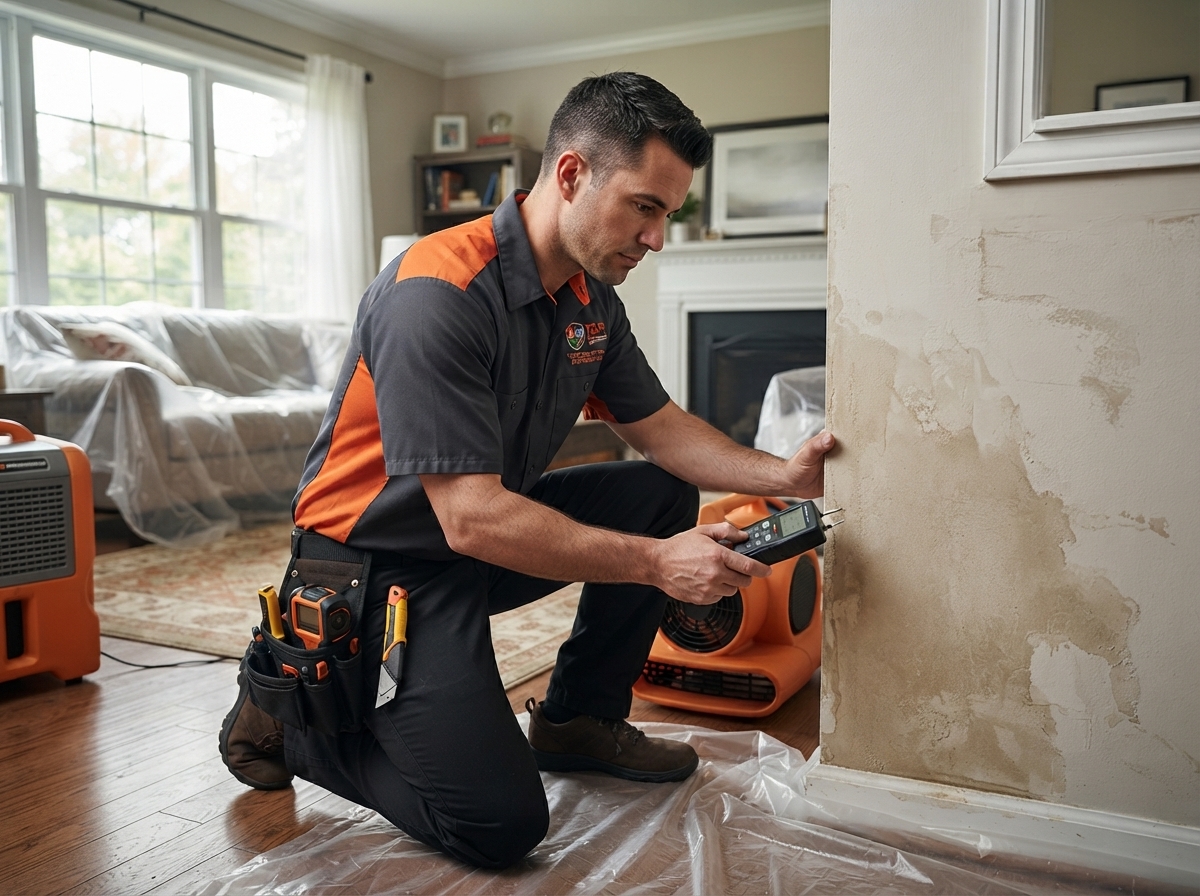
Upon arrival, emergency crews establish safety controls and evaluate structural stability. Specialists utilize FLIR infrared cameras and non-invasive moisture meters to track water migration paths behind plaster walls, beneath stone flooring, and inside lower-level wall cavities.
Phase 2: High-Volume Industrial Fluid Extraction
Truck-mounted extraction units and heavy-duty submersible pumps extract standing floodwater rapidly. Removing liquid water at the start dramatically reduces overall drying times and halts moisture absorption into structural framing.
Phase 3: Biohazard Removal & Antimicrobial Decontamination
For Category 3 flood situations, technicians safely remove unsalvageable porous building components (such as flooded carpet padding, lower drywall, and wet fiberglass insulation). All remaining non-porous surfaces and concrete slabs undergo heavy pressure washing and applications of EPA-registered antimicrobial agents.
Phase 4: Industrial LGR Dehumidification & Cavity Injection Drying
Specialists install commercial Low-Grain Refrigerant (LGR) dehumidifiers paired with high-velocity air movers to establish a controlled closed-loop drying environment. Directed wall cavity injection systems pump dry air behind baseboards and structural studs to pull out trapped moisture without requiring full wall teardowns.
Phase 5: Daily Dry-Out Logging & Complete Reconstruction
Technicians take daily moisture readings across all affected building materials until structural elements reach certified baseline dry standards. Once cleared, skilled craftspeople restore drywall, replace flooring, match architectural textures, and return the building to its pre-loss state.
Real-World Scenarios: Managing Structural Water Emergencies
Scenario A: Subterranean Garage and Lower-Level Storm Flooding
Severe rainstorms caused surface runoff to overwhelm a residential drainage system, sending six inches of mud and rainwater into a subterranean parking area and adjacent home theater. Emergency teams established Category 3 biohazard controls, extracted standing liquid, removed impacted lower drywall under negative air pressure, sanitized the concrete slab, and thoroughly dried the structural framing.
Scenario B: Multi-Story Supply Line Pipe Burst
An upper-floor copper pipe burst in a multi-level residence while the family was away, sending thousands of gallons of water downward through ceilings, light fixtures, and hardwood floors. Specialists deployed thermal imaging to map hidden water paths, installed weighted vacuum floor mats to draw trapped moisture out through the hardwood planks, and utilized LGR dehumidifiers to dry the ceiling joists intact.
Frequently Asked Questions (Q&A)
What should I do immediately after discovering indoor flooding?
If it is safe to do so, turn off your property’s main water shutoff valve and switch off circuit breakers to affected rooms to eliminate electrical hazards. Avoid stepping in standing water, especially if it stems from an unknown or contaminated source. Call a certified emergency restoration team immediately to begin water extraction.
Can water damage from overland flooding cause mold to grow inside walls?
Yes. Microscopic mold spores exist naturally in the air and germinate rapidly when exposed to organic building materials (like drywall paper or wood studs) and relative humidity levels above 60%. Active fungal growth can form inside damp wall cavities within 24 to 48 hours following a flood event.
How do restoration experts determine if structural materials are completely dry?
Restoration technicians do not rely on visual checks or surface feel. They utilize calibrated moisture meters and thermo-hygrometers to take daily readings of wood studs, drywall, and subfloors, comparing them against unaffected control materials until certified dry standards are met.
Will my property insurance cover flood restoration expenses?
Standard property insurance policies usually cover sudden and accidental internal water damage (such as burst pipes or appliance line leaks). However, overland storm flooding typically requires a separate flood insurance policy (such as through the NFIP). Professional restoration teams provide detailed thermal logs, moisture charts, and itemized billing to work directly with your insurance adjuster.
Need Immediate Assistance? Contact Our Beverly Hills Team Today
When water emergencies threaten your home or commercial facility, every minute counts. Tech Solution Restoration provides 24/7 rapid-response water extraction, advanced structural drying, and complete property recovery tailored to Beverly Hills and nearby service areas. We handle the entire process from initial containment to direct insurance billing.
Don’t wait for hidden moisture to cause structural rot or mold growth. Call our certified local specialists now for immediate dispatch!
- Brand Name: Tech Solution Restoration
- Address: 8909 W Olympic Blvd Unit 208, Beverly Hills, CA 90211
- Phone Number: (310) 857-8767
- Emergency Line: Available 24 Hours / 7 Days a Week
READ MORE: